Abhijit Sarkar
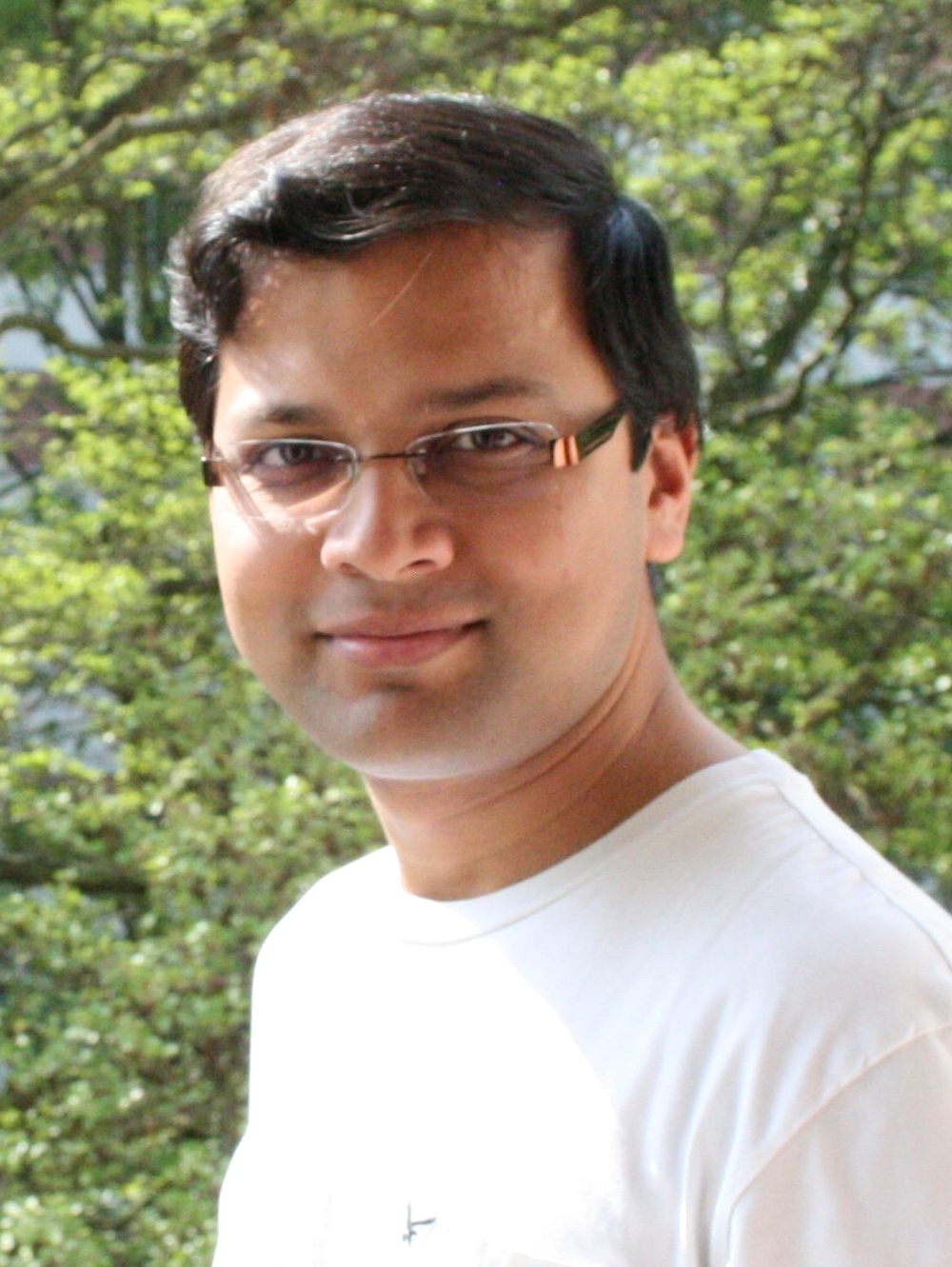
Greetings!
Welcome to my
website. I am a color scientist, whose interests range from various
fundamental aspects of color and vision sciences to industrial
applications involving digital color imaging, for example displays and
cameras.
I completed a PhD from Technicolor Research & Innovation, Rennes, France in October 2011. I was affiliated to the IRCCyN-IVC Laboratory, (Institut de Recherche en Communications et en Cybern�tique de Nantes), a part of Ecole Polytechnique de Nantes and the University of Nantes, Nantes. University of Nantes is the second largest university in France in terms of student population.
This page contains my professional and academic information. More details on my research, including publications are available in the research page. For everything else, please visit my Personal page.
My latest resume is available here.
What is color science? What can you possibly do with a degree in color science?
I encounter these questions all too often while describing to someone my work, so I would like to make an attempt to explain in simple terms why the world should need people calling themselves experts in color science. Think about your camera, your printer, your television set, or even your iPOD and mobile phones (including iPhone of course). The high quality of color in these devices that you have come to take for granted is not actually very easy to achieve. The manufacturers of these devices need color scientists and engineers to develop methods and algorithms (probably in collaboration with hardware and software engineers) to achieve superior color experience. A lot has to do with the fundamentals of human vision and perception, that is, how our visual system works and perceives colors. Once you have a fair amount of knowledge on these basic sciences, the next challenge is to apply this knowledge in a specific application domain and come up with an engineering solution. It is not hard to imagine it needs specialized knowledge and professional experience. The imaging industry is just one example where color experts are needed. Other examples include the media and entertainment industry (can partly fall under imaging as well), paint manufaturing, cosmetics manufaturing, so on and so forth.
The field of color science is quite interdisciplinary, involving physics, chemistry, physiology, statistics, computer science and psychology. Many people in this industry, like myself, have an interdisciplinary background. You cannot be a good color expert just with an electrical engineering background, neither can you survive simply with a physiology or psychology degree. This is also the reason why color science is a fascinating field. It is truly a confluence of science and engineering.
There are many interesting websites on color science. A fascinating website is http://www.cis.rit.edu/fairchild/WhyIsColor/. You can look at http://www.cis.rit.edu/mcsl/outreach/faq.php. A more technical website is http://www.brucelindbloom.com/. Of course, these are only three out of...a lot, I think.
Education
I finished my undergraduate degree in Electrical Engineering from Jadavpur university, in Kolkata (Calcutta), India in 2000. My specialization was Illumination Engineering. In January 2003, I moved to the US for my graduate studies. I earned my first MS in Architectural Engineering (Lighting/Electrical) from Pennsylvania State University in 2005. My second MS was in Color Science from the Munsell Color Science laboratory under Center for Imaging Science, Rochester Institute of Technology in 2008.
In October 2011,
I earned a PhD in Applied
Automation and Computer Science from the University
of Nantes, France. I was part of the Image and
Video Communications Group at the IRCCyN laboratory, a part of Ecole Polytechnique
de Nantes.
My area of focus continued to be color science (even though the program name does not make it evident), and I am still looking for ways to incorporate lighting into my work. Interestingly, in the early days, many pioneers in the field of color science were originally lighting researchers!
Research Interests
My principal area of interest is digital color imaging. A lot of my current and past work involved color appearance and vision, perceptual color processing for still images and video, image/video quality and visual psychophysics.
Research
The PhD thesis research, completed in August 2011, focused on the fundamental issue of observer variability and its effect on various applications in the media and entertainment industry, in particular, those involving modern display colorimetry. The thesis was titled: Identification and Assignment of Colorimetric Observer Categories and Their Applications in Color and Vision Sciences .
My strength, I believe,
is in my motivation and perseverance for research, coupled with an
interdisciplinary background in electrical engineering, lighting and
color
science. I
love to do something new. My first MS
thesis and my independent project was on a novel application of digital
imaging in
lighting control that eventually led to an independent project and
subsequently a new collaboration opportunity (which unfortunately never
materialized). The
second MS thesis resulted in a
Even though I just
completed my eight-year stint as a graduate student, I still continue
to learn, and continue to mature as a researcher. I feel I have been
fortunate so far in finding exciting research projects and career
opportunities. I look forward to the future with the same expectation.
For details of my various research projects, please visit my research page.
Three patent applications have been filed during the course of my graduate studies. A new invention disclosure has been filed, and should result in another patent by early 2011.
-
A. Sarkar, L. Blond�, P. Morvan, �Method for the classification of observers according to their visual characteristics�, European Patent Application #10290193.1, filed by Thomson Licensing on April 9, 2010
-
A. Sarkar, L. Blond�, J. Stauder, �Method for controlling an image display device to allow the same perception of colours over a large variety of observers�, European Patent Application #10290194.9, filed by Thomson Licensing on April 9, 2010
-
A. Sarkar, J.E. Caviedes, and M. Subedar, �Joint enhancement of lightness, color and contrast of images and video�, US Patent Application #20100085487 filed by Intel Corporation on September 30, 2008
Internships
My first internship in the field of color science was in the summer of 2006, as a college intern in the Color and Imaging Science team under Digital Printing Technologies Group, Hewlett-Packard Company in Vancouver, Washington, USA. The principal assignment was to develop a framework for conducting psychophysical image quality experiments for image quality (IQ) evaluation in the product development phase. I developed a GUI-based software tool in Matlab that helped design and conduct psychophysical experiments. The software also analyzed the observer data and generated results in the form of graphs and tables.
In summer 2007, I worked as a Technical Intern in the Digital Home Group at Intel Corporation in Chandler, Arizona, USA. During this internship, I was involved in the development of a new, integrated method for color and contrast enhancement. Part of the work was to conduct subjective test to evaluate the performance of the new algorithm. This was part of my MS thesis research.
What's new?
I went through several
life-changing events within a short span of 3 months - the bereavement
from my mother's sudden demise (December '12), getting married to my
wife Rinku (January 16, '13) and starting my position at Microsoft
(March '13).
I would love to hear from you too - whether you are a friend, family or a visitor I don't know yet. I will appreciate if you sign my guestbook below.
I
periodically update the
content on this and other pages. Sure they are very simple, but for the
time being my only goal is to share my information with the world. It
has already helped me build new professional contacts. One day I hope I
will learn (and have some time) to add some fancy stuff to my
website. Anyway, thank you for visiting my website and
hope to see you back in near future.
Microsoft
15101 NE 40th St
Redmond, WA 98052
E-mail: sarkar....at....abhijitsarkar.....dot.....com


Note on internet browser: This website has been tested in Internet Explorer 8 (Win XP) with a screen resolution of 1280x800.
This page was last modified on June 23, 2013. Modified 23 times since June 17, 2006.
Copyright� Abhijit Sarkar 2013. All rights reserved.